Many developing countries have a warm or hot climate, and often they have sufficient land for land-intensive wastewater treatment technologies (WSP for example). They should take maximal advantage of their climate and their climate land availablilty for wastewater treatment. Money spent on land is not money wasted, but money spent on electricity is money gone for ever.
Thus the most sustainable options for domestic wastewater treatment in developing countries are likely to be:
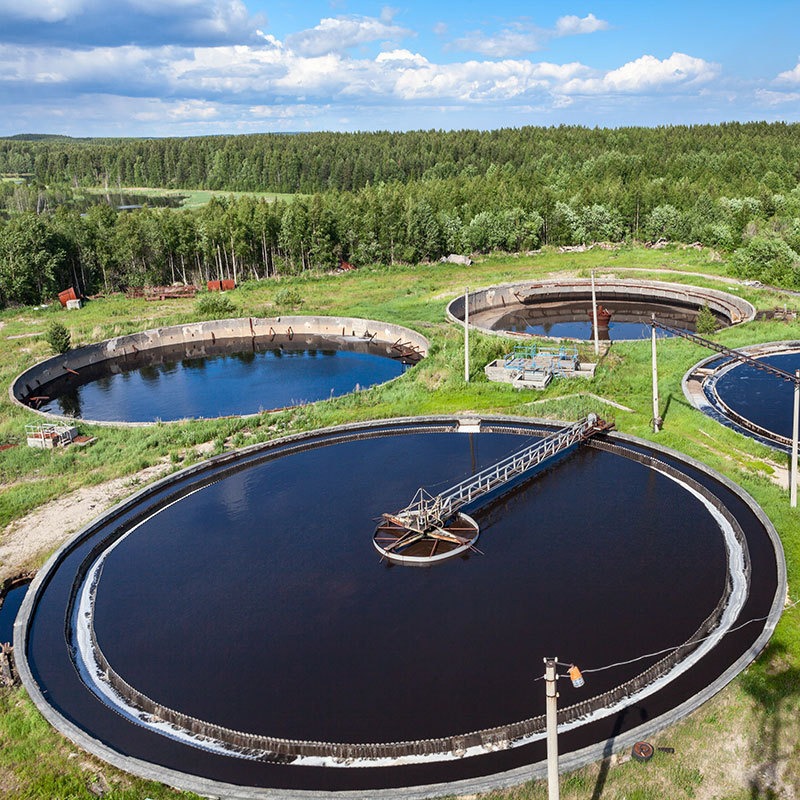
* anaerobic technologies, such as anaerobic ponds (especially high-rate anaerobic ponds) and maybe UASBs, and
* photosynthetic technologies, such as facultative and maturation ponds and maybe constructed wetlands.
Generally these two ‘natural’ processes are used in series, treating the wastewater first anaerobically and then photosynthetically. Given modern design the land take for these natural systems need not be as large as their ‘opponents’ commonly suppose or might suggest. One example will suffice here:WSP have been described as suitable ‘only if land is relatively cheap ’. This translates to WSP being suitable at land prices up to US$150,000/ha, which is in fact a very high price for land near almost all towns and cities in developing countries – the best agricultural land in industrialized countries is worth much less than this.
If a move is made away from these natural treatment processes, then there is in effect a trade-off: more money needs to be spent on both capital and operation and maintenance (O&M) costs, and less on land, In simple financial terms, such as a discounted cash-fow analysis, it is basically almost a straight comparison between land costs and the costs of electromechanical equipment and the electricity used. Higher-tech systems are only appropriate when the land for natural systems really is not there. Then one should move up the higher-tech ‘ladder’ very cautiously, always considering the least higher-tech options first and the most high-tech systems last. It will often be instructive, especially for large wastewater treatment projects, and particularly when high-tech solutions are being considered, to undertake a Bayesian benefit-risk analysis to determine the most sustainable option).