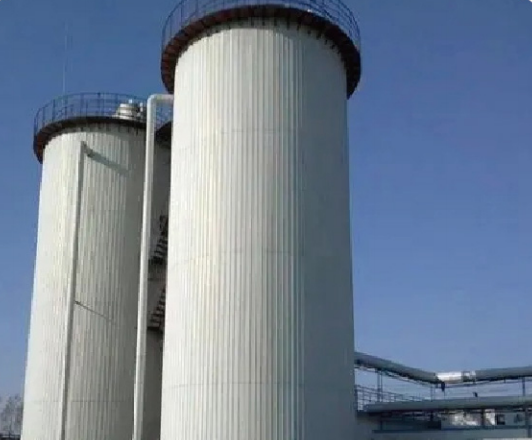
The core function of an ozone reaction tower is to utilize the strong oxidizing properties of ozone (O3) to efficiently remove pollutants from water or gas through physical, chemical, or catalytic reactions, while achieving sterilization, disinfection, decolorization, and deodorization. The following is a detailed summary of its core functions:
- Degradation and removal of pollutants
Organic decomposition:
Ozone can directly oxidize and decompose organic compounds (such as COD, BOD, phenols, pesticides, etc.) in water, converting them into carbon dioxide, water, or small molecule inorganic substances. Under catalytic oxidation conditions (such as using catalysts such as diatomaceous earth and activated carbon), ozone can generate hydroxyl radicals (· OH), further non selectively mineralizing highly stable organic compounds and improving treatment efficiency.
Inorganic treatment:
It can oxidize and remove heavy metal ions such as iron and manganese, as well as toxic inorganic substances such as sulfides and cyanides in water, reducing their toxicity or converting them into precipitable forms for easy separation.
Ammonia nitrogen and total phosphorus removal:
Through ozone oxidation, ammonia nitrogen is converted into nitrate, total phosphorus is converted into phosphate, and combined with subsequent precipitation or filtration processes to achieve deep denitrification and phosphorus removal. - Sterilization and Microbial Control
Efficient inactivation of pathogens:
Ozone can destroy the cell walls and genetic material of microorganisms such as bacteria, viruses, and algae, quickly killing common water pathogens such as Escherichia coli, Cryptosporidium, and Giardia, and preventing disease transmission.
Broad spectrum bactericidal activity:
It is equally effective against microorganisms that are difficult to treat with traditional disinfectants such as drug-resistant bacteria and spores, and is free from disinfection by-products such as trihalomethanes (THMs) that may be produced during chlorine disinfection.
Application Scenario:
Widely used for disinfection of drinking water, treatment of hospital wastewater, purification of swimming pool water circulation, and sterilization in the food processing industry. - Discoloration and deodorization
Chromaticity removal:
Ozone can oxidize and decompose chromophores (such as conjugated double bonds and aromatic compounds) in water, significantly reducing the color of wastewater. It is suitable for the treatment of high color wastewater such as printing and dyeing, papermaking, etc.
Odor elimination:
By oxidizing odorous substances such as hydrogen sulfide and methyl mercaptan, removing odors from water or gas, and improving environmental quality. - Preprocessing and Deep Processing
Enhance biodegradability:
In industrial wastewater treatment, ozone oxidation can destroy the structure of large molecular organic matter, convert it into small molecule easily degradable substances, increase the BOD/COD ratio of wastewater, and create conditions for subsequent biological treatment.
Deep purification:
As a secondary or tertiary treatment process, it further removes trace pollutants (such as endocrine disruptors, drug residues, etc.) that are difficult to treat with traditional processes, meeting reuse or emission standards. - Environmental Protection and Sustainability
No secondary pollution:
Ozone quickly decomposes into oxygen after reaction, with no residual chemicals, avoiding long-term environmental impact.
Resource utilization:
The treated water can be reused for industrial cooling, landscape irrigation, or urban miscellaneous water, achieving water resource recycling.