1. The coagulant in sewage treatment mainly refers to polyaluminium chloride (PAC): it is a high-efficiency inorganic polymer coagulant, which is produced by the bridging effect of hydroxide ions and the polymerization of multivalent anions. Compared with traditional coagulants, PAC has the remarkable characteristics of fast floc formation, fast sedimentation rate, wide pH range, and low corrosion to pipeline equipment.
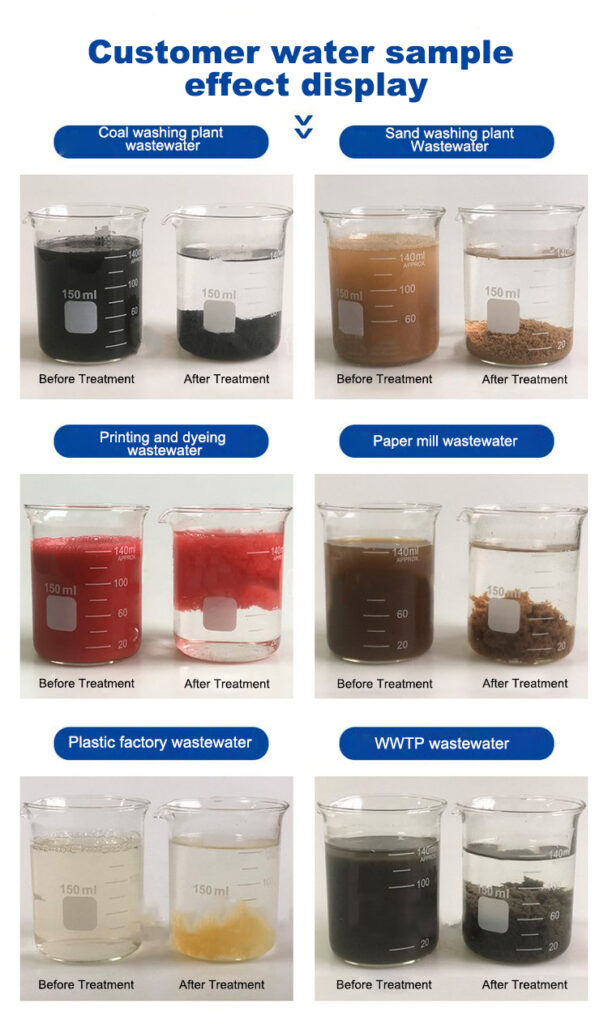
2. Polyaluminium chloride is an inorganic polymer coagulant, and its coagulation effect is as follows:
① Strong electrical neutralization effect on colloidal substances
② Excellent bridging adsorption effect of hydrolysis products on suspended matter in water
③ Selective adsorption effect on soluble substances
3. Performance: The water quality after purification is better than that of aluminum sulfate flocculant, and the water purification cost is 15-30% lower than that of aluminum sulfate. The floc formation is fast, the sedimentation rate is fast, and the treatment capacity is greater than that of traditional products such as aluminum sulfate. The alkalinity of the consumed water is lower than that of various inorganic flocculants, so no or less alkali agent can be added. The source water PH5.0-9.0 range can be coagulated. Less corrosive, good operating conditions. Better solubility than aluminum sulfate. Less salt increase in treated water, conducive to ion exchange treatment and high-purity water production. Better adaptability to source water temperature than inorganic flocculants such as aluminum sulfate.
4. Properties: Very soluble in water. Aluminum sulfate cannot dissolve in pure sulfuric acid (just coexist), but dissolves in water with sulfuric acid in sulfuric acid solution, so the solubility of aluminum sulfate in sulfuric acid is the solubility of aluminum sulfate in water. It precipitates at room temperature and contains 18 molecules of crystal water, which is 18-hydrate aluminum sulfate. Most of the industrial production is 18-hydrate aluminum sulfate. Contains 51.3% anhydrous aluminum sulfate, which will not dissolve itself even at 100°C (dissolves in its own crystal water). It is not easy to weather and lose crystal water, and is relatively stable. It will lose water when heated, and will decompose into aluminum oxide and sulfur oxides at high temperature. It begins to decompose into aluminum oxide, sulfur trioxide, sulfur dioxide and water vapor when heated to 770°C. Soluble in water, acid and alkali, insoluble in ethanol. The aqueous solution is acidic. Aluminum hydroxide is generated after hydrolysis. The long-term boiling of aqueous solution can generate basic aluminum sulfate. The industrial product is grayish white flake, granular or block, with a light green color due to the low iron salt content, and the surface turns yellow due to the oxidation of low-valent iron salt. The crude product is grayish white fine crystal structure porous. Non-toxic, dust can irritate the eyes.
5. Precautions:
5.1 Precautions for operation: Closed operation, local exhaust. Operators must undergo special training and strictly abide by the operating procedures. It is recommended that operators wear self-priming filter dust masks, chemical safety glasses, anti-toxic penetration work clothes, and rubber gloves. Avoid dust. Avoid contact with oxidants. Load and unload gently during transportation to prevent damage to the packaging. Equipped with leakage emergency treatment equipment. Empty containers may have residual harmful substances.
5.2 Dissolution requirements: solid PAC should be prepared into 5-10% solution, and the dissolution time should be ≥30 minutes; liquid PAC can be directly added or diluted to 3-5%
5.3 Dosing point selection: usually located at the entrance of the mixing tank, and multi-point dosing can be considered when treating high turbidity water
5.4 Equipment maintenance: regularly clean the dosing pipeline to prevent crystallization blockage
5.5 Compatible use: when used in combination with PAM, PAC should be added first and then PAM, with an interval of ≥1 minute
5.6 Storage conditions: solid products should be moisture-proof and sealed, and liquid products should be stored in a cool and ventilated warehouse to avoid freezing (storage temperature>5℃). Keep away from fire and heat sources. It should be stored separately from oxidants and should not be mixed. The storage area should be equipped with suitable materials to contain leaks.
6. Usage calculation formula:
6.1 Theoretical dosage (kg/d) = [flow (m3/d) × dosage (mg/L)] / 1000
6.2 Considering product purity (η): actual dosage = theoretical dosage / η (generally liquid PAC η=10%, solid η=30%)
6.3.1 Drinking water treatment
Surface water: 5-30mg/L (in terms of Al?O?)
Reservoir water: 3-15mg/L
High algae water: need to increase dosage by 50% and cooperate with pre-oxidation
6.3.2 Urban sewage treatment
Primary treatment: 20-50mg/L
Secondary effluent deep treatment: 10-30mg/L
Sludge conditioning: 2-5% of dry sludge volume
6.3.3 Industrial wastewater
Papermaking wastewater: 50-150mg/L
Printing and dyeing wastewater: 80-200mg/L
Food processing wastewater: 30-100mg/L
Oil-containing wastewater: 40-120mg/L